Inclusive and responsible density matters in Cape Town
25 June 2026
STATEMENT BY THE DEPUTY MAYOR EDDIE ANDREWS
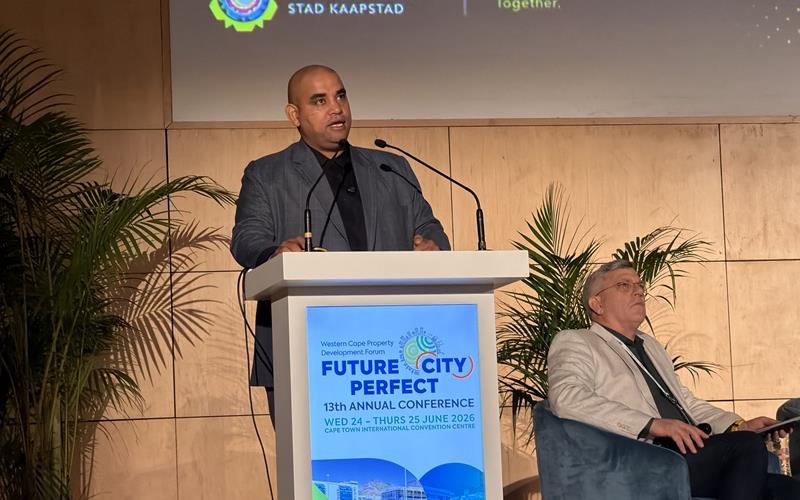
Alderman Eddie Andrews, the City’s Deputy Mayor and Mayoral Committee Member for Spatial Planning and Environment, addressed attendees at the Western Cape Property Development Forum’s annual conference at the Cape Town International Conference Centre Earlier today. The theme for this year’s conference is ‘Future City Perfect’. Below is Alderman Andrews’s speech.
Cape Town’s biggest risk is not that we do not know what needs to be done, but that we move too slowly to do it.
We know we need more housing.
We know we need more infrastructure.
We know we need better-located development.
We know we need density that works.
AND we know we need the public and private sectors to work differently.
The question is whether we are prepared to change the systems that stand between our vision and delivery, which is why this room matters: because the future city will not be decided in a strategy document.
It will be decided in the systems we fix, the infrastructure we fund, the approvals we unlock, the partnerships we make real, and the developments that actually take place. This is a room of people who shape the city – not in theory, but in land, capital, infrastructure, risk, design, delivery and long-term urban value.
The future city will not be perfect. Cities are not perfect things. They are complex, living systems. They are contested. They are dynamic. They are constantly changing. But the future city must be more intentional, inclusive, more resilient and more capable of delivery.
Cape Town’s future will not be built by government alone. It will be built where public purpose and private capability meet with infrastructure as the backbone, communities at the centre, and dignity as the measure of success.
So today, I want to speak plainly about three challenges I often hear developers face, and what we must do about them.
The first challenge is uncertainty in the development system.
Developers understand risk. You understand markets, finance, and complexity. But uncertainty in the public approval system is a different kind of risk. When timelines are unclear, departments are not aligned, and applications move through the system without visibility, the cost is not only carried by the applicant. It is carried by the city. It slows housing. It slows investment. It slows job creation. It slows the future.
That is why we need to modernise the systems behind development approvals.
A one-stop development approval system is one way to do this: not to lower standards or bypass public participation, but to improve coordination, transparency and speed.
There is also a role for the responsible use of AI: to support faster screening, better tracking, clearer information flows, and to free up professional planners to focus on complex, high-impact applications where judgement is needed most.
The proposed Building By-law amendments are part of this shift: creating a clearer, more efficient and more responsive system for applicants, officials and communities. This is not administrative reform for its own sake. It is a growth-enabling investment.
While government has a role to play in providing certainty, the private sector also has a role to play: certainty of intent, quality and social responsibility.
The second challenge is infrastructure capacity.
Every serious conversation about density eventually becomes a conversation about infrastructure. Water. Sanitation. Electricity. Roads. Stormwater. Public transport. Public space.
Developers need to know where growth can be supported, where capacity is constrained, and where future upgrades are planned.
Communities need to know that density will not come at the expense of basic services.
And government must be honest that we cannot speak about future cities without speaking about how we fund the infrastructure that makes those cities work. Density without infrastructure is irresponsible. But infrastructure without development is unaffordable.
The task is not to choose between infrastructure and development, but to align them.
That means clearer infrastructure pipeline visibility. It means better coordination between capital budgets, planning approvals, transport corridors, and development incentives. It means development charges that are transparent and clearly linked to the infrastructure required for growth.
It means being open to more innovative tools.
If public investment creates private value, then part of that value must help fund the infrastructure, transport, public space, and affordable housing that make the city work.
The third challenge is building in a city where affordability, community trust and spatial inequality remain real.
The real test of urban transformation is not what the skyline looks like, but whether more people can access the opportunities beneath it.
Can a young person from Mitchells Plain, Khayelitsha, Delft, Atlantis, Philippi or Hanover Park see a future in this city? Can a worker live closer to employment? Can a family spend less time travelling and more time living? Can growth restore dignity?
Affordability is not only a housing question. It is a city-structure question.
It is about where people live. How far they travel. What transport choices they have. How close they are to jobs, schools, clinics, parks and public facilities. And whether the shape of the city helps or hurts the household budget.
Affordability is not only the price of a unit. It is the full cost of living in the city.
It is the rent, yes. But it is also the taxi fare, the time spent travelling, the cost of electricity, and the distance from work, school, clinics and opportunity.
In many communities, affordability is measured in the smallest daily transactions: the house shop that sells two tea bags, a small packet of sugar, or a few rand of electricity because that is what a household can manage that day.
So, when we speak about development, we cannot only ask whether a project is viable on paper. We must ask whether the city around it makes life more affordable, more accessible and more dignified.
That is why inclusive density matters.
But let me be clear: density is not the enemy. Poorly planned density is.
Good density, done with dignity, is one of the most powerful tools we have to build a more inclusive Cape Town.
Public participation cannot be treated as a compliance exercise at the end of a process. Communities are not obstacles to be managed. They are part of the city-building ecosystem.
If we want to build faster, we must build trust earlier.
My challenge to this room is direct: Do not ask government only for speed. Ask us for certainty, coordination and courage - and hold us accountable to that.
But also ask yourselves: what kind of city is your investment building?
Is it deepening exclusion, or expanding access? Is it adding pressure, or helping solve pressure? Is it simply extracting value, or helping create long-term public value? Is it designed only for the market of today, or for the city we need tomorrow?
Cape Town’s future cannot be left to chance. It must be planned. It must be financed. It must be built. And it must be built together.
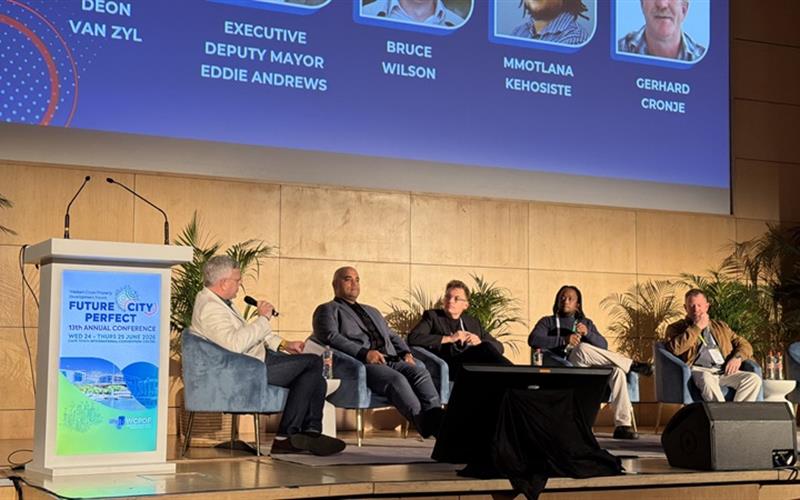
Captions: Alderman Eddie Andrews, the City’s Deputy Mayor and Mayoral Committee Member for Spatial Planning and Environment, addressed attendees at the Western Cape Property Development Forum’s annual conference at the Cape Town International Conference Centre Earlier today. From left to right are Deon van Zyl, WCPDF Chair; Ald. Andrews; Bruce Wilson, founder of Bruce Wilson Architects; Mmotlana Kehosiste, Development Manager at Citra; and Gerhard Cronje, CEO of Maskam Water.
End
Published by:
City of Cape Town, Media Office